IN THEIR OWN WORDS · A PROSECUTOR WROTE TO THE CHIEF JUDGE
“I just can no longer ignore it.”
“Looked at as a whole, it is clear to me that there is a concerted effort by some judges to rule against Mr. McCleary to the best of their ability. I didn’t want to believe him but having witnessed this with my own eyes now, I just can no longer ignore it and I concur with his concerns.”
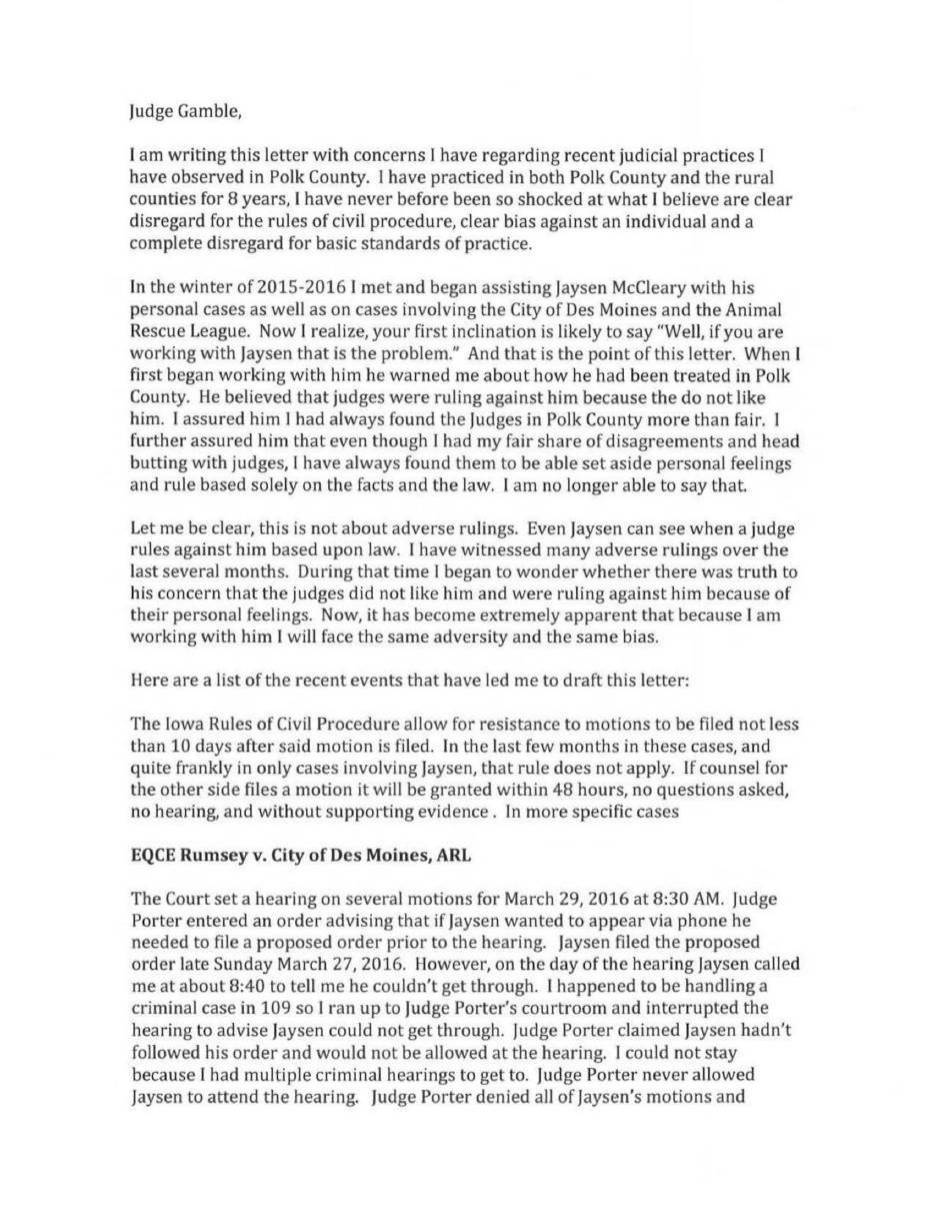
In July 2016, a practicing Iowa attorney who worked beside me in Polk County wrote to Chief Judge Arthur Gamble. The letter lists, case by case, the rules of civil procedure the attorney watched the court ignore. The attorney had practiced for eight years and had “never before been so shocked” at the “clear disregard for the rules of civil procedure” and the “clear bias against an individual.” That attorney is now an Iowa prosecutor, so the name is redacted.
I was licensed to practice law in Iowa in 1998. I went on to earn an MBA and spent about ten years on Wall Street, as a Managing Director at Bear Stearns and a Vice President at Deutsche Bank. Then I came home to do the work I believed in.
Since 2014, I have practiced civil rights law exclusively pro bono. I did it for free, for people who had no voice and no money to defend themselves: families whose dogs were seized, people the City had decided not to listen to. Most of them told me no other lawyer would take their case.
Then the courts suspended my license without a hearing, before or after, and my clients' civil rights cases ended with it. I am not asking anyone to feel sorry for me. I am asking you to see who paid the price. Every ruling made to stop me also stopped the family waiting on me. When the courts went after their lawyer, those families lost the one person standing up for them.
01 / WHY VOTE NO
Judges are on the ballot, too.
Families came to me after the City took their dogs. They had no money, and no other lawyer would take their cases. I took them and charged nothing. I was the only lawyer in Des Moines practicing civil rights law exclusively, and I did it pro bono.
Then the courts went after the lawyer instead of deciding the cases.
Judge McAllister and Judge Crane let the City kill Odin, a nine-year-old girl's service dog, with a month left to appeal. Read Odin's story ↓ The City's own board approved my animal shelter. Judge Seidlin wrote that the board never voted.
A judge owes you one thing: the truth of the record. Each ruling below names the judge who made it, with the record cited. This is not about me. It is about the next family that walks into the courthouse with no money and no lawyer.
Merriam-Webster defines corruption, in sense 1a, as “dishonest or illegal behavior especially by powerful people (such as government officials or police officers).” Look at what the record shows. Judge Seidlin wrote that the Board “never” voted, after the City’s own brief admitted the Board granted the relief (D0148; D0166). Judge McAllister called a hearing officer’s decision “a judgment against the Plaintiff” and, in the same ruling, admitted it “is not a final judgment.” He then denied Odin’s release before the affidavit deadline he set had run. Judge Crane lifted the stay while the family still had a month to appeal, then cancelled the emergency hearing after the City reported Odin dead. That is not honest with the record. Read the record and judge for yourself.
I am a native Iowan. In March 2007, at Bear Stearns, I warned in writing that the housing market would fall at least 10% within a year. I was told to mind my own business. The crash came in 2008.
In my pro bono work, I proved four ordinances unconstitutional and saw them repealed, got the breed-specific law in Hubbard, Iowa, repealed, and saved more than ten dogs from being killed illegally.
Court decisions took away my license and ended that work.
03 / THE JUDGES
Vote NO.
On November 3, I’m asking voters to vote no on keeping these six judges.
NOJoseph W. Seidlin
NOScott J. Beattie
NOCelene M. Gogerty
NOLawrence P. McLellan
NOSarah E. Crane
NOColeman J. McAllister
Polk County · Judicial District 5C
JUDGE CELENE M. GOGERTY
She judged her own recusal, then locked the door on my defense.
In April 2019, I moved to recuse Judge Gogerty. She ruled on that motion herself and denied it.
On June 2, 2021, at 7:51 a.m., I asked to amend my answer to plead the absolute litigation privilege (D0274). Trial was five days away, and my shoulder surgery was the next morning. At 8:25 a.m., thirty-four minutes later, she denied it in two sentences and gave no reason (D0276).
The defense went unheard at trial. On appeal, the Iowa Court of Appeals held that the privilege “must be pled and proved” (No. 21-1900, n.4). I tried to plead it. The court locked the door, then faulted me for not walking through it.
On February 8, 2022, Judge Gogerty filed a disciplinary complaint against me. The next day, she recused herself (D0635).
JUDGE JOSEPH W. SEIDLIN · CITY OF DES MOINES v. McCLEARY · EQCE084655
The City said yes. He said the City never voted.
In 2014, I asked the City's Building and Fire Appeals Board to approve the animal shelter I built in my backyard. On April 10, 2014, the Board moved to "define the structure as an 80 square foot animal enclosure with covered run that is exempt from permits" (City Ex. 10, p. 2).
In 2019, the City sued me over that same structure. My request to continue the trial was denied (D0140), and on February 17, 2022, Judge Seidlin tried the case with me appearing by telephone (D0142; D0144). The City's own post-trial brief admitted the permission: "On April 10, 2014, the Building and Fire Appeals Board granted Mr. McCleary relief by defining the chicken coop structure as having 80 square feet of area to resolve building permit issue" (City Post-Trial Brief, Mar. 4, 2022, D0148). The City argued only that the structure had since grown or that the relief rested on wrong facts. It never argued that the Board failed to vote.
Judge Seidlin made that argument for the City. His March 16, 2022 ruling says "the minutes do not set forth that there was any vote on the motion" and "the court was presented with no evidence that the Motion ever passed" (D0166, pp. 4, 7). The City had already conceded that the Board granted the relief. He then ordered me to remove the structure within ninety days and authorized the City to enter my property and do it (D0166, ¶¶ 2–3). The same day, he dismissed all of my counterclaims against the City with prejudice (D0167).
The case is over. The Iowa Supreme Court dismissed my appeal (No. 22-1059; D0180, Oct. 14, 2022), and procedendo issued on November 2, 2022 (D0182).
JUDGE SCOTT J. BEATTIE
He knowingly gave away federally exempt money.
On April 5, 2022, Judge Beattie gave $12,828.03 of my federally exempt money to the plaintiffs’ law firm (D0724). Federal law protects that money from creditors and from courts, and he knew it. He gave it to the plaintiffs anyway. On October 16, 2023, when I asked for it back, he refused. A judge who knowingly violates federal law should not keep his seat.
JUDGE COLEMAN J. McALLISTER · SIGLER v. CITY OF DES MOINES · EQCE085957
No testimony, no evidence, and a “judgment” he admitted was not one.
Judge McAllister refused to bring Odin home, called a hearing officer’s decision “a judgment against the Plaintiff” while admitting it “is not a final judgment,” and took no testimony. Read Odin’s story ↓
JUDGE SARAH E. CRANE · SIGLER v. CITY OF DES MOINES · EQCE085957
She lifted the stay, and the City killed Odin that night.
Judge Crane lifted the stay that kept Odin alive while the family still had a month to appeal. The City killed him that evening. Read Odin’s story ↓
04 / THE DOGS
Why my billboard names Des Moines and the ARL.
My billboard says: “Letting Des Moines and the ARL kill dogs unconstitutionally.” Dog owners were denied a fair chance to challenge the seizure and killing of their dogs. These are a fraction of the cases.
ODIN · SIGLER v. CITY OF DES MOINES · EQCE085957 · JUDGES COLEMAN J. McALLISTER & SARAH E. CRANE
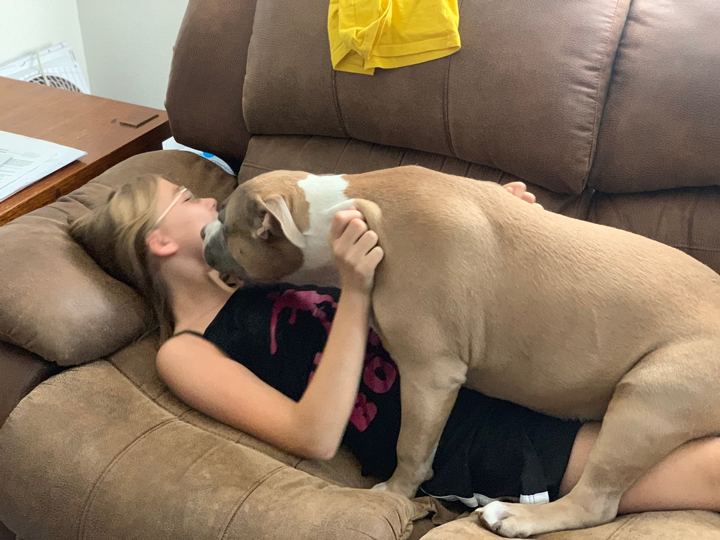
Odin with the girl he served.
Odin was a service dog, and he did nothing wrong.
Odin was a nine-year-old girl’s service dog, and he did nothing wrong.
The City of Des Moines took him. In the summer of 2020, I asked the court to bring Odin home. On August 7, 2020, Judge Coleman McAllister refused by calling a hearing officer’s decision “a judgment against the Plaintiff,” and in the same ruling he admitted it “is not a final judgment.” At the August 28, 2020 evidentiary hearing, the girl’s father and his dog-bite expert were on the video call, ready to testify. Judge McAllister took no testimony. He ordered affidavits due by the close of business Monday, August 31, then denied Odin’s release at 4:38 p.m. that day, before the deadline ran, “after hearing the argument of counsel.”
On February 15, 2022, Judge Sarah E. Crane lifted the stay that kept Odin alive. The City killed him that evening. Its own filing says so: “The City of Des Moines carried out the euthanasia on the evening of February 15, 2022.” The family still had until March 18, 2022 to appeal. I filed an emergency motion to put the stay back. On February 17, two days after Odin died, Judge Crane’s office set an emergency hearing and instructed the City “not to euthanize the dog pending the hearing.” The City called the request “moot, as the euthanasia was carried out,” and Judge Crane cancelled the hearing.
My law license was later suspended without a hearing. Read why ↓
A court that will not hear the evidence, and then lets the government make an appeal pointless, has not decided a case. It has ended one. A nine-year-old girl lost her service dog without anyone ever hearing why he should live. Judge McAllister and Judge Crane are on this ballot.
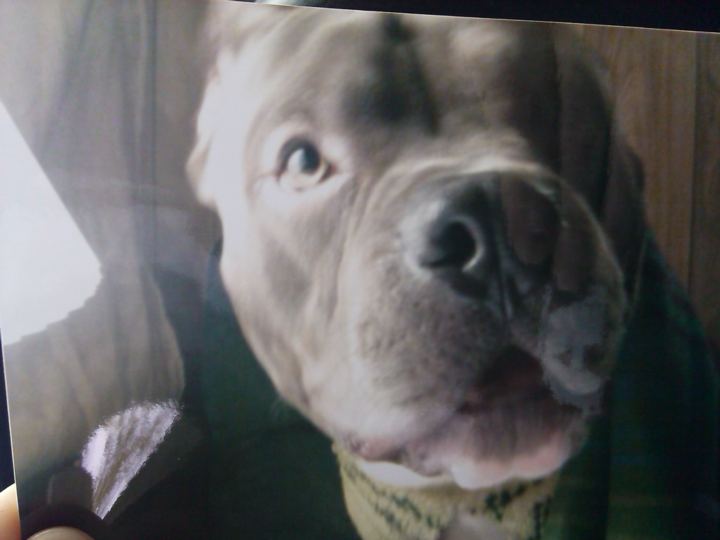
HILDRETH / JOHNNY CASH
Johnny Cash.
“I met Cash, who is very friendly.”
Heather Hildreth was a single mom with two young kids. She did not have much money. She had Cash. In her own words to the court, Cash “helped us emotionally through some very tough times with his unconditional love for us. He has become our emotional support and we miss him dearly and we know he misses us.”
Des Moines Animal Control Officer Tina Updegrove wrote in her report: “I met Cash, who is very friendly.” The City’s own lawyer admitted in court that Cash was friendly to adults. A child poked Cash in the eye, and Cash did what any hurt animal does. At Broadlawns, the doctors used no stitches. They glued the scrapes closed.
The City seized Cash in September and kept him in a kennel through the winter. Heather’s children made him a sweater to keep him warm. On February 20, 2015, Judge Stovall lifted the stay that protected him. Johnny Cash was not spared. The ARL took him out of his kennel and killed him in his sweater, days before a trial to bring him home. On February 27, 2015, the court dismissed the case to return him as moot.
The City then said it cremated him in his sweater, and turned Heather away when she came to pick up his remains because she did not arrive between noon and 3 p.m.
I still think about that officer’s words. I met Cash, who is very friendly. A family that loved its dog deserved a day in court while he was alive.
FAHRNEY / DIESEL · EQCE079408 · APPEAL 19-0093
Diesel, alone in the kennel.
Do you think a doctor doesn’t know what a dog bite looks like?
Kurt Fahrney had no home. He had Diesel. For a man with nothing else, a dog is shelter of another kind.
A little boy got a cut, less than an inch long, running across his throat. The City blamed Diesel. The doctors did not. The Des Moines police supplemental report of October 8, 2015 records that doctors at Lutheran Hospital “did not believe that the child’s injuries were consistent with a dog bite.” At Blank Children’s Hospital, a trauma surgeon said the injuries “are not typical for a dog bite.”
I went to the yard and saw the spiked chain-link fence. Gina Johnson, Kurt’s sister and director of a wellness clinic for 15 years, saw the boy on October 6. Under oath she said: “It wasn’t a bite.” Asked about puncture wounds, she answered: “None.”
The City held that police report and did not give it to us before the hearing, though the hearing officer had ordered the records produced. The September 8, 2016 ruling acknowledged the City had not produced them, then called it harmless.
On August 2, 2018, ARL attorney Jason M. Casini wrote that the ARL was on “stand by.” City attorney John Haraldson directed that Diesel be euthanized. I wrote back: “I strongly encourage you and your clients to keep the dog alive.” They killed Diesel that morning, between 11:30 and 11:45.
The doctors’ words sat in the City’s own file the whole time. A government that hides the evidence that would save a life has not given anyone a hearing. It has given them a ceremony.
Simba was a family dog, and Chelsea loved him the way a family loves the dog that waits at the door. The City took him for one reason: someone thought he looked like a “pit bull.” (The case record carries her sister’s name; Chelsea was Simba’s owner.)
No breed by that name exists. Des Moines Municipal Code § 18-41 names the Staffordshire terrier, the “American pit bull terrier,” and the American Staffordshire terrier, then reaches any dog with “the appearance and characteristics” of one. Under that rule, a family could lose its dog for the shape of its head.
Chelsea asked me to help. On July 24, 2015, I got the “pit bull” ordinance declared unconstitutional as applied to Simba. Administrative Law Judge Heather L. Palmer reversed the City because it relied on a breed checklist and criteria the ordinance never published. People should not have to guess which rules govern their families.
The City released Simba. Then it charged him again, as a “pit bull.” That second charge was retaliation.
Des Moines still labels dogs “high risk” by breed and appearance. A law that judges a dog by how it looks will judge people the same way. I believe the City adopted this ordinance to keep minorities out of neighborhoods, and I want it ended.
Twenty-two months in a kennel over Facebook posts.
Malice went into a kennel with a black patch around one eye. When she came out, that patch had turned gray.
Malice was more than a pet. Her owner had survived a home invasion, and Malice was trained to walk through every room of the house so her owner could feel safe again. When the City took Malice, it took that safety too, for almost two years.
Animal control came to her home on March 13, 2015, after someone called about Facebook posts. Those posts were the only evidence the City used to say Malice attacked other dogs. Her veterinarian’s records showed the opposite: other dogs had attacked Malice.
I represented her family. In that case, Judge David M. Porter told me I could appear by phone if I filed a proposed order first. I filed it. On the morning of the hearing I could not get through, and he would not let me in. He then denied every one of my motions and granted every one of the other side’s.
On December 30, 2016, an Iowa district judge ruled that the City had failed to provide substantial evidence that Malice was dangerous. On January 3, 2017, after 22 months in a kennel, Malice went home. Arthritis had stiffened her legs. She pulled hard on the leash anyway, to reach the person she loved.
Nearly two years of a dog’s life is a long time to wait for a government to admit it had no evidence. The burden belonged to the City from the first day. Malice carried it instead.
Ms. Pesce had four dogs, Huk, Fifel, Layzee, and Ricky, and she wanted every one of them home.
The police report recorded the mail carrier’s account: one of Ms. Pesce’s dogs scratched his leg. The City did not identify which dog. It nevertheless took all four and transferred them to the ARL.
I challenged that decision and requested an appeal. On April 6, 2016, ARL attorney Jason Casini wrote that the City agreed “no appeal is available.” I disputed that position and demanded confirmation that all four dogs remained alive.
I also sought a practical resolution. On April 5, I proposed allowing Ms. Pesce to recover her own dogs by paying the adoption fees. My purpose was straightforward: return the dogs and avoid further expense to the taxpayers. Casini rejected the offer the following day.
On April 7, 2016, the Iowa Supreme Court entered a stay that kept the ARL from destroying or adopting out Ms. Pesce’s dogs while she pursued her appeal. On June 1, Judge David M. Porter denied her application to get the dogs back. Before 8 a.m. the next morning, I perfected her appeal to the Iowa Supreme Court and filed notice of it. On June 6, after that appeal had taken the case out of his hands, Judge Porter vacated the stay anyway.
Ms. Pesce never got a hearing for her dogs. I filed her case in equity. The court moved it to small claims and dismissed it there, where an appeal is only discretionary.
A practicing Polk County attorney who watched these events wrote to Chief Judge Arthur Gamble on July 22, 2016: “Looked at as a whole, it is clear to me that there is a concerted effort by some judges to rule against Mr. McCleary to the best of their ability. I didn’t want to believe him but having witnessed this with my own eyes now, I just can no longer ignore it and I concur with his concerns.” Read the full letter (author’s name redacted) →
In the dog cases I handled, the City never offered a settlement, compromise, or negotiated resolution. That repeated refusal deserves an explanation.
Four dogs waited in kennels while lawyers wrote emails about whether their owner even had a right to appeal. A court order protecting them should have meant something. Every family deserves that much.
My concern is that continued litigation generates additional legal fees for the ARL’s private attorney, Jason Casini of Whitfield & Eddy. The public deserves an explanation for rejecting practical settlements while the expense of litigation continues to grow.
West Des Moines declared Jimmy “vicious” after a minor incident and set out to kill him.
I fought for Jimmy. The evidence and testimony showed a friendly dog, and I showed he could work as a service dog. In August 2014, the City admitted Jimmy was not vicious and lifted the order to destroy him.
Then the City of Des Moines, right next door, refused to renew Jimmy’s license, solely because of his breed. After refusing to sell me the license, it had me arrested for not having one. Officers arrested me in court, in my suit, on the same day I was due to appear for Malice. My client in Malice’s case had a panic attack. It was the first time in my life I had ever been arrested.
A city that refuses to sell a license, then arrests the lawyer who freed the dog on the day he is due in court for another family, does not enforce the law. It sends a message to anyone who would stand up for their dog. Jimmy lived. The people who sent that message still owe the public an answer.
The court opinions and email exchanges in the record show the events, the positions, and the rulings.
05 / THE “DOG LAWYER” STORY
What the newspaper left out.
In my injury case against the City of Des Moines, LACL134328, Judge Jeffrey Farrell protected my medical records. When some were filed without a confidentiality mark by mistake, the City’s lawyers pointed the Des Moines Register to them. On November 16, 2017, Judge Farrell ordered that all copies “inadvertently not designated as ‘Confidential’ shall be immediately destroyed” by any third party and not disclosed. Reporter Clark Kauffman was personally served with that order on November 27, 2017.
I asked the courts to enforce it. On December 11, 2017, Justice David Wiggins stayed publication. The full Iowa Supreme Court dissolved the stay on December 19. On December 20, the Register ran Kauffman’s front-page story, “Iowa’s ‘dog lawyer’ spars with judges, confounds court system.” The coverage called it a fight over the First Amendment. It was a fight over a court order protecting my medical records.
The story led with Chief Judge Arthur Gamble’s September 2017 order sanctioning me about $25,000 and calling me incompetent. Gamble issued that order after the case had been removed to federal court, when he had no jurisdiction. On November 20, 2017, he vacated it, declaring “The September 1, 2017 order is void.” The Register never reported that.
The story quoted Judge Mary Pat Gunderson saying I made “a farce of the judicial system.” She said it when I objected that Iowa Rule 1.943 let me dismiss my client’s case without prejudice, and she told me to sit down. The Register left that out too.
The story ran on the front page. The next day, I settled my injury case.
06 / MY LICENSE
Suspended without a hearing.
On February 8, 2022, Judge Gogerty filed a disciplinary complaint against me, and she recused herself the next day (D0635). On May 16, 2022, before any hearing, the Iowa Supreme Court suspended my law license (No. 22-0778). It set a hearing, then on June 7, 2022 continued it with no new date. On May 1, 2023, it denied my request for a hearing. The suspension ended the civil rights cases I was bringing for Odin’s family and for many other families whose constitutional rights were violated.
I am asking for one thing on November 3: vote no on Seidlin, Beattie, Gogerty, McLellan, Crane, and McAllister. Judges must answer to the people.
— Jaysen McCleary
07 / THE CHANGES I WANT
What I want for Iowa.
These are the changes I planned to bring home to Iowa voters.
Mental health education in every school.
I want emotional intelligence and mental health taught as the fourth basic skill, right beside reading, writing, and math. It starts in kindergarten and grows through 12th grade, so every child learns to handle stress, respect boundaries, and protect themselves from abuse. A public dashboard tracks the progress of every district. Pair it with stand-alone mental health hospitals, so people in crisis get real help instead of a jail cell or an ER hallway, and Iowa saves lives, cuts bullying, and becomes the model for the nation.
2. ### Judicial reform.
Judges must follow the record and the law, the same rules for everyone. Cases built on hidden or made-up evidence deserve a second look.
3. ### Better pay for public servants.
Teachers, bus drivers, jurors, and the people who keep Iowa running. You get what you pay for. Pay well, and better people do these jobs. Jury service should never cost someone their rent.
4. ### Independent oversight of government.
An independent office to investigate fraud and abuse wherever it happens: judges, legislators, executive officials, anyone in power. Protect and reward the people who prove it, and hold the investigators to the same standard.
5. ### No immunity for malicious misconduct.
Officials who abuse their power on purpose should answer to a jury. No immunity for malice, corruption, retaliation, or made-up facts.
6. ### Stronger protection for animals.
Animals cannot vote or speak for themselves. They deserve real protection, and the people entrusted with their care deserve real accountability.
7. ### Fines for deliberate media lies.
When a jury finds a news outlet published a false fact it knew was false, it should pay. Opinions, criticism, and honest mistakes stay protected.
Reforms Iowa needs in the executive branch.
I am calling on Iowa's leaders to adopt these reforms.
Reform 1: An Office of Independent Oversight.
Create an office of auditors and investigators who report directly to the Governor, investigate misconduct in state agencies, report what they find to the public, work with the Attorney General and federal authorities on matters outside the executive branch, and publish their findings every quarter.
2. ### Reform 2: A code of ethics for the executive branch.
Ban conflicts of interest in state contracting. Require senior officials to disclose financial ties and outside jobs. Bar relatives of agency heads and contracting officers from state contracts. Require yearly ethics training for every executive branch employee.
3. ### Reform 3: Open state contracts.
Post every contract, bid, and renewal over $50,000 on one free, searchable public website, with a plain-language summary of its terms and cost. Post renewals and amendments within 10 days of approval.
4. ### Reform 4: Protect whistleblowers.
Keep the identity of anyone who reports misconduct confidential. Make retaliation grounds for firing and referral to the Attorney General. Give whistleblowers a confidential hotline run by the Governor's Office of Ethics and Oversight.
08 / MAKE YOUR VOICE COUNT
Tuesday. November 3.
Iowa polls are open 7 a.m. to 8 p.m. Central time.


 Download QR code ↓